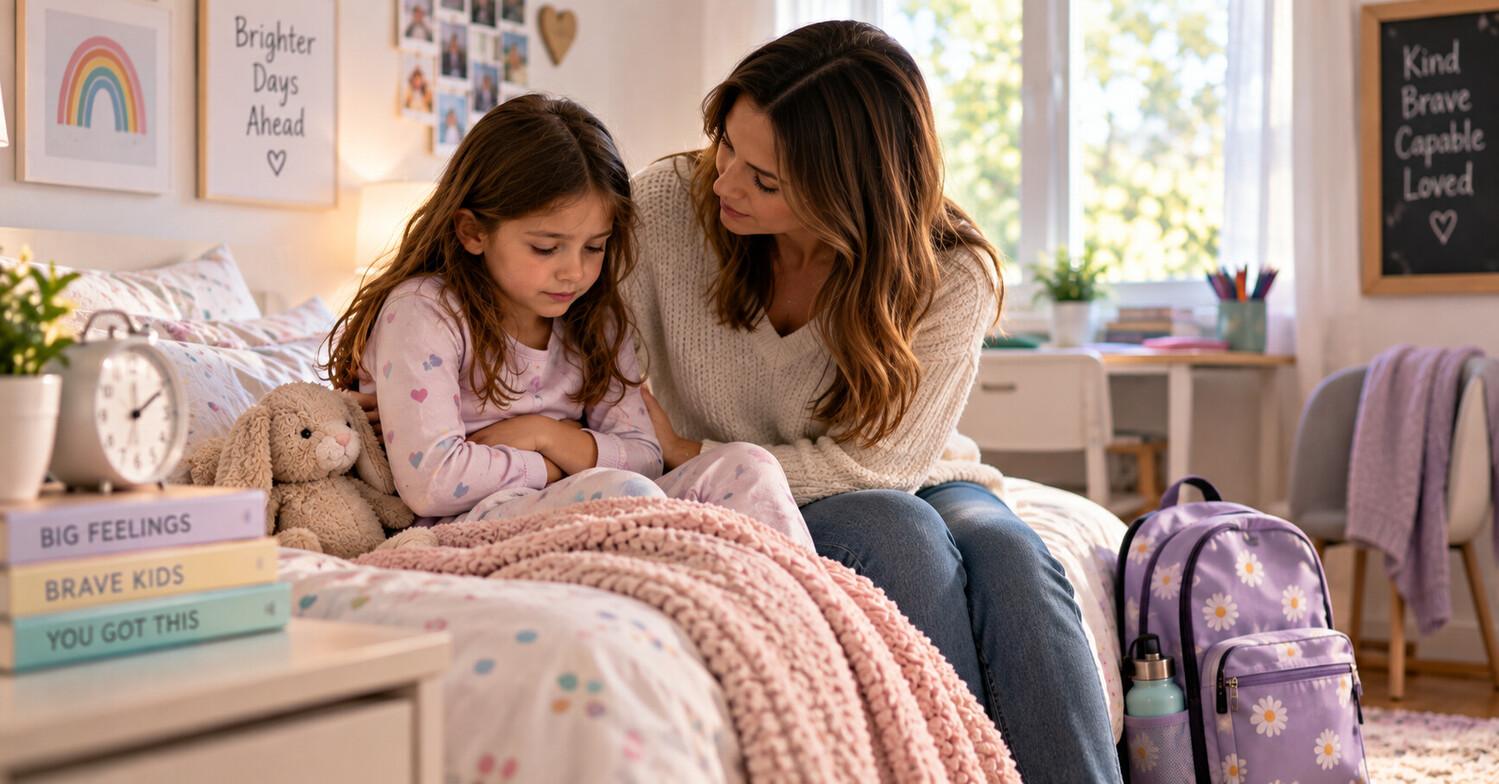
It's 7:15 in the morning, everyone is trying to get out the door, and suddenly your child says:
“My stomach hurts.”
Again.
Maybe it happens on Sunday nights. Maybe it's worse on test days. Maybe your child seems completely fine on weekends but regularly complains of stomachaches, nausea, or headaches before school.
Parents can quickly find themselves wondering:
Is my child actually sick? Are they trying to avoid school? Could this be anxiety?
The answer isn't always obvious.
One thing is important to understand: when anxiety causes physical symptoms, those symptoms are real.
Your child isn't necessarily pretending or exaggerating. The connection between the brain and body means that stress and anxiety can be experienced physically—even when a child doesn't recognize that they're feeling anxious.
At the same time, physical symptoms shouldn't automatically be attributed to anxiety. Medical causes need to be considered when appropriate.
So how can parents begin to understand what may be happening?
Can Anxiety Really Cause Stomachaches in Children?
Yes.
When we feel anxious, the body's stress response can affect multiple systems—including the digestive system.
Children may experience:
- Stomach pain
- Nausea
- Headaches
- Feeling shaky
- A racing heart
- Muscle tension
- Dizziness
- Fatigue
- Difficulty sleeping
- Changes in appetite
For some children, these physical sensations may be easier to recognize than the emotion underneath them.
A child may not say:
“I'm worried about going to school today.”
They may simply know:
“My stomach hurts.”
And it really does.
Why Does My Child's Stomach Hurt Before School but Not on Weekends?
Patterns can provide useful information.
If stomachaches happen primarily before school, on Sunday evenings, before tests, presentations, social events, or other stressful situations, anxiety may be one factor worth considering.
That doesn't prove anxiety is the cause.
But it gives parents something important to pay attention to.
Ask yourself:
When does this happen?
When does it get better?
What is happening immediately before the symptoms begin?
Are there particular days, classes, activities, or situations when it seems worse?
A child who regularly feels sick before school but feels significantly better once allowed to stay home may be experiencing a pattern in which anxiety and avoidance are becoming connected.
The next question becomes: What about school feels difficult?
What Could My Child Be Anxious About at School?
There isn't always one obvious reason.
A child may enjoy school overall and still experience anxiety about certain parts of the day.
Possible concerns include:
- Tests or academic performance
- Making mistakes
- Being called on in class
- Presentations
- Separation from a parent
- Friendship difficulties
- Bullying or peer conflict
- Lunch or recess
- A particular class
- Feeling behind academically
- Fear of disappointing a teacher or parent
- Using the bathroom at school
- Changes in routine
- Social situations
- Perfectionism
Sometimes children can tell parents exactly what is bothering them.
Other times, they genuinely don't know.
That's why repeatedly asking “What are you worried about?” may not always produce an answer.
Is My Child Sick or Anxious?
Sometimes it's difficult to tell—and parents shouldn't be expected to diagnose the cause themselves.
Physical symptoms should be taken seriously.
If your child's stomachaches are new, persistent, worsening, severe, or accompanied by other concerning symptoms, talk with your child's pediatrician or medical provider.
A medical evaluation can help determine whether there is a physical condition contributing to the symptoms.
It is also possible for both things to be true.
A child can have a medical issue and experience anxiety about the symptoms. Anxiety can also intensify the way physical discomfort is experienced.
The goal isn't to choose between:
“It's physical” or “It's anxiety.”
It's to understand the whole child.
Is My Child Faking a Stomachache to Stay Home From School?
This is where language matters.
If your child feels better after learning they can stay home, it can be tempting to conclude that they were pretending.
But consider what happens when an anxious person learns they no longer have to face the thing they fear.
Their anxiety decreases.
And as their nervous system settles, physical symptoms may decrease too.
That doesn't necessarily mean the original stomachache wasn't real.
It may mean that removing the stressful situation brought relief.
This distinction matters because responding to an anxious child as though they are being dishonest can create additional conflict around school without addressing the underlying problem.
Why Can Staying Home Make School Anxiety Harder?
When a child is genuinely uncomfortable, allowing them to avoid the situation can feel like the most compassionate response.
Sometimes staying home is absolutely appropriate—especially when a child is ill.
But when anxiety is driving repeated school avoidance, a cycle can develop:
School feels scary → stomach hurts → child stays home → anxiety decreases → staying home feels safer.
The relief reinforces the avoidance.
The next school morning may then feel even harder.
This doesn't mean parents should simply force an extremely distressed child into school regardless of what is happening.
It means repeated school avoidance deserves attention so that the underlying concern can be identified and addressed.
The goal is to help children develop the confidence and coping skills needed to tolerate manageable discomfort rather than allowing anxiety to gradually make their world smaller.
How Should I Respond When My Child Says Their Stomach Hurts Before School?
First, stay calm.
You can take the physical complaint seriously without immediately assuming either illness or anxiety.
You might say:
“I believe that your stomach hurts. Let's figure out what your body might be telling us.”
That communicates something important:
I believe you.
Then become curious about patterns rather than interrogating your child in the middle of a stressful morning.
Later, when things are calmer, you might ask:
“I've noticed your stomach seems to bother you more on school mornings. Have you noticed that too?”
For younger children, it may help to connect body sensations with emotions:
“Sometimes our bodies give us clues when we're worried. Where do you feel worry in your body?”
The goal isn't to convince your child that the stomachache is “just anxiety.”
It's to help them begin recognizing the connection between thoughts, emotions, situations, and physical sensations.
What Can Parents Do About School-Related Anxiety?
Predictability can help.
Consistent morning and bedtime routines, adequate sleep, preparation the night before, and reducing unnecessary morning chaos can make school days feel more manageable.
Parents can also help children practice coping skills when they are calm—not only when anxiety is already high.
Depending on your child's age, that might include breathing exercises, grounding techniques, positive coping statements, identifying worries, or creating a manageable plan for difficult situations at school.
Be mindful of repeated reassurance as well.
If your child asks:
“What if my stomach hurts at school?”
rather than promising:
“It won't,”
you might help build confidence:
“If your stomach feels uncomfortable, what are some things you can do to help yourself through it?”
That shifts the message from:
“Nothing uncomfortable will happen.”
to:
“You can handle uncomfortable feelings.”
When Should I Consider Therapy for School Anxiety?
Consider additional support when anxiety or physical symptoms are persistent, increasing, or beginning to interfere with your child's ability to attend school, participate in activities, sleep, separate from caregivers, or function comfortably in everyday life.
Therapy may help children:
- Understand the connection between thoughts, emotions, and physical sensations
- Identify triggers for anxiety
- Develop coping and emotional regulation skills
- Build confidence tolerating uncomfortable feelings
- Reduce avoidance
- Communicate worries more effectively
- Gradually return to activities anxiety has made difficult
Parent involvement can also be important, particularly with younger children.
Sometimes small changes in how adults respond to anxiety can help a child build greater confidence over time.
Child Anxiety Therapy in Boca Raton, Florida
At ThriveSky Therapy, we provide in-person therapy for children and teens in Boca Raton, Florida, with telehealth options available throughout Florida when clinically appropriate.
Our therapists work with children experiencing anxiety, school stress, emotional regulation difficulties, avoidance, perfectionism, self-esteem concerns, family transitions, and other emotional or behavioral challenges.
For children, therapy may incorporate developmentally appropriate approaches such as play, creative activities, emotional identification, coping strategies, and skill-building rather than relying only on conversation.
Parents are also an important part of the process.
We want families to better understand not only what their child is doing, but what may be contributing to it and how they can support healthier coping outside the therapy room.
If your child's stomachaches, headaches, or other physical complaints seem connected to school stress or anxiety, a free consultation with ThriveSky Therapy can help you discuss what you're noticing and determine whether therapy may be an appropriate next step.
When School Stress Starts Looking Different in the Teen Years
As children get older, school anxiety may change.
A younger child may say:
“My stomach hurts. I don't want to go to school.”
A teenager may keep going.
They may earn good grades, take challenging classes, participate in activities, and appear to be doing well.
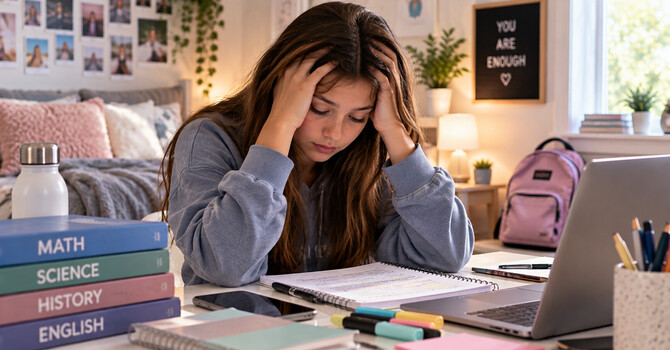
But underneath that success may be constant worry about grades, fear of making mistakes, pressure to get into the “right” college, comparison with peers, perfectionism, lack of sleep, or the feeling that nothing they accomplish is ever quite enough.
Because these teenagers are still functioning—and sometimes excelling—their stress can be easy to miss.
So when does being motivated become being overwhelmed?
And how can parents support achievement without allowing anxiety and perfectionism to take over?
Next in our Anxiety in Children & Teens Series: Why Is My Teenager So Stressed About Grades?